 Fiber
 Connect
 Omnipub

The Entmoot Decision
One of the world’s oldest, slowest industries is colliding with its newest, fastest technology. Publishing has always led more as a loose collaboration rather than a unified force. Similar to the Ents, until Isengard.
A few weeks ago at the STM Conference in Frankfurt, I sat on a stage in front of roughly 400 executives from the world's leading STM publishers.
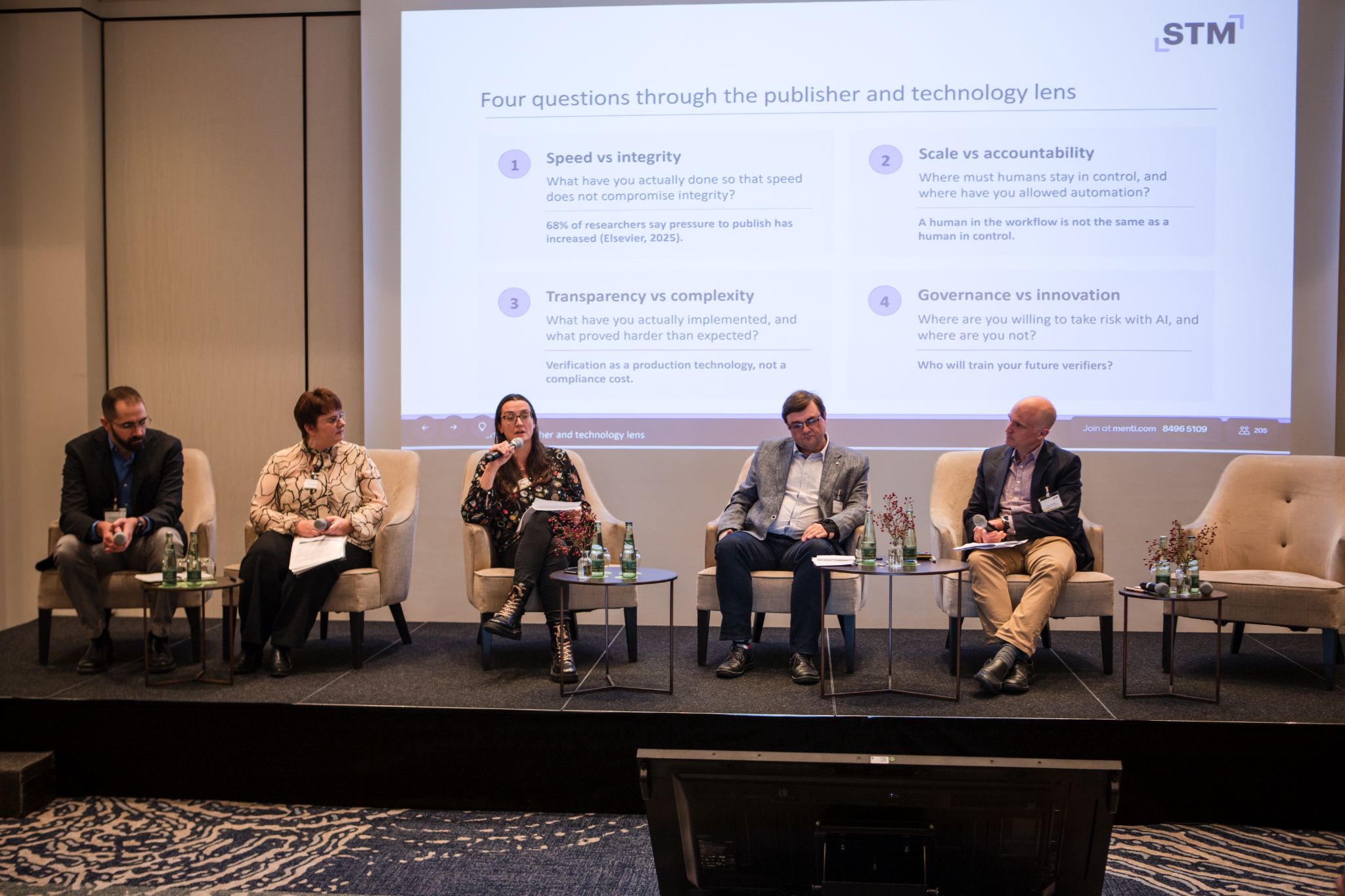
The session was moderated by Rob Johnson of Research Consulting, and it was billed as a debate: Trust by Design: Who decides where AI stops, and humans begin?
We spent the better part of two hours on governance, provenance, and accountability. Then Rob closed with one last question for the panel.
"What's one decision you know you need to make, but have been putting off?"
He asked the panel. But you could feel it land on the whole room.
Everyone has an answer to that question. None of us want to say it out loud.
I had mine. It had come into focus a few hours earlier, over lunch.
What's different this time
Prior to the session, I was having lunch with fellow panelist, Kim Eggleton. Kim heads Peer Review and Research Integrity at IOP Publishing, and she has spent the better part of two and a half decades directly in this industry. By comparison, I've spent about five years working alongside it.
We talked about all the challenges she’d seen over that time. Print to digital. The rise of the aggregators. Amazon going direct to readers. Google becoming the front door to everything. Each one felt existential at the time, and the industry came through every one of them.
Then I asked the question I realized I was most curious about.
"How does this challenge feel by comparison?"
She didn't hesitate. "Oh, this feels dramatically different."
"Why? What's the difference?"
"It's the speed."
That's stuck with me ever since, because of what it's colliding with.
Publishing is one of the oldest industries in the world. Cambridge University Press received its royal charter from Henry VIII in 1534 (source). Wiley started as Charles Wiley's print shop in Manhattan in 1807 (source). Johns Hopkins University Press, the oldest continuously running university press in the United States, dates to 1878 (source).
It's also, by its nature, one of the slowest. A book can take years to reach the market. Peer review takes months. Historically, when the ground has shifted under publishing, it's shifted slowly enough to watch it coming, debate it, and adapt.
Now one of the oldest, slowest industries in the world is colliding with one of the newest, fastest technologies ever built.
And this isn't a nuisance. It's existential.
Sitting across from Kim, I had a strange sense of déjà vu. I'd felt this before.
Peacetime and wartime
In my head, I was back at our previous company before Cashmere.
Munk and I had inherited a business that was built in peacetime. It had raised a lot of money. It could afford to spend. The founding team had moved on to their next ventures, but the way they'd run the company stayed behind. Deliberate. Comfortable. Consensus first. Nobody had done anything wrong. It's just what everyone was used to.
The problem was that the conditions had changed, and the company hadn't. We were “default dead”.
The language that finally helped us talk about it came from the investor, Ben Horowitz. In his book, The Hard Thing About Hard Things, he draws a line between peacetime, when a company has a large advantage in a growing market, and wartime, when it's "fending off an imminent existential threat." Each demands a completely different way of operating. The peacetime CEO "strives for broad based buy-in." The wartime CEO "neither indulges consensus-building nor tolerates disagreements."
That was us. A peacetime company in a wartime situation.
So Munk and I stood up in front of the whole company and named it. Here's what peacetime looks like. Here's what wartime looks like. Here's how we're going to make decisions now, and here's what we're going to stop doing. We put it all on a single slide:
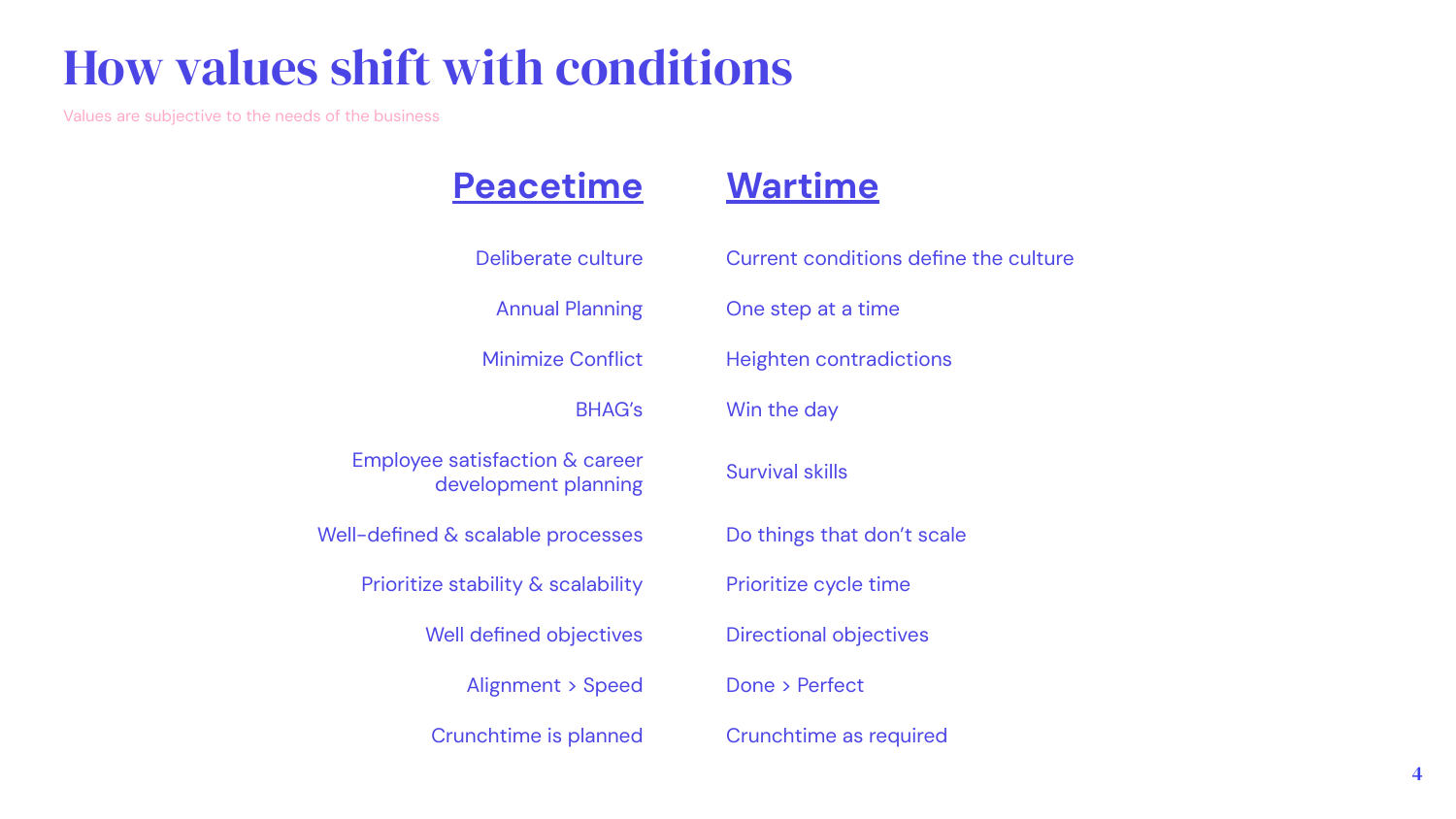
The slide wasn't really the point. Naming the shift out loud was.
We got focused. We moved faster. We made decisions. Some people who weren't aligned with the new direction left. And we landed big-name clients, closed six-figure contracts, and grew the business.
To be clear, that's not a universal definition of wartime. It's what it meant for us, a startup, at that moment. Peacetime isn't wrong. Running a peacetime playbook in a wartime situation is.
Which brings me back to the answer I gave on stage.
My answer
At Cashmere, the decision we've been putting off is this: how much do we collaborate, and how much do we dictate?
We've spent years thinking about how AI systems should access content, license it, and pay for it. We've sat on both sides of the table. Our data points aren't the only valid ones, but they're battle-tested and well earned. And we know the best way to build a movement is to bring people along with you, not hand them a blueprint. By nature, we're collaborators.
But the temptation to dictate is always there.
It's the same tension Horowitz describes. Buy-in, or no consensus-building. Peacetime, or wartime.
That's the decision I'd been putting off. And sitting next to Kim, I started to wonder if we weren't the only ones…
Can an industry go to war?
Step back and look at what publishing is facing.
A threat to how content is discovered, accessed, and paid for. A technology moving faster than anything the world has ever seen. Business models that have held for generations, suddenly in question.
That's Horowitz's definition of wartime almost word for word: "fending off an imminent existential threat."
Except publishing isn't a company, like Horowitz wrote about.
A company has a CEO. When the moment comes, someone can stand up in front of the team, the way Munk and I did, and say, this is how we operate now.
Who does that for an industry?
Publishing is an ecosystem of presses, societies, aggregators, and libraries, each with its own board, its own mission, and its own timeline. Getting all of them to recognize the moment, let alone move together, is a different problem entirely.
Maybe the industry is already at war, and I'm just not seeing it.
It doesn't feel like it, though.
I see it in my own work every week. We bring publishers real opportunities: buyers who are ready to transact, who want to license content legitimately and pay for it, but through AI, not the traditional routes. And then it's three to six months of back and forth. Licensing rights. Permissions. Pricing models. Another round of review.
Every one of those conversations is reasonable on its own. Together, they're peacetime behavior.
Meanwhile, the ground keeps shifting under our feet.
The Entmoot
So what does wartime look like for a publisher?
I can't tell you. I've never worked inside one. And I don't think the answer is "act like a startup." A 500-year-old institution isn't a twenty-person company with runway measured in months or years, and it shouldn't pretend to be.
But the image that keeps coming back to me is the Entmoot.

In the Lord of the Rings films, the Ents are ancient guardians of the forest. When the war comes to their doorstep, they gather in council to decide whether to join it. It takes them hours just to say hello. They deliberate carefully, at length, the way ancient things do. And after all of it, they decide this isn't their fight.
Then Treebeard walks to the edge of the forest and looks out toward Isengard. Stumps where his trees used to be. Everything burned.
One look. That's all it takes.
He lets out a war cry, and all those hours of careful deliberation suddenly don't matter.
It's hard to picture the Ents going to war. They're slow. They're ancient. They're huge. They're deliberate. They're trees, for heaven's sake. But the moment you watch them tearing boulders loose and hurling them through the walls of Isengard, they're terrifying.

I keep thinking about what publishing looks like when it reaches the edge of its own forest. When an industry with five hundred years of weight behind it finally decides to move.
I don't know what that looks like. But I've seen what the Ents did to Isengard.
The Ents put off the decision to go to war until they literally couldn't avoid it.
In Frankfurt, Rob asked a room of 400 publishing leaders what decision they'd been putting off. The panel answered out loud. The rest of the room didn't have to.
I can't help but wonder if, for a lot of them, it was the same decision the Ents put off.
Sources
STM Conference; Rob Johnson; Kim Eggleton; Ben Horowitz, The Hard Thing About Hard Things
Stay in the loop
Get the latest insights on AI, content licensing, and the future of publishing.
Read More
 AI PublishingAI Content Strategy
What Does It Mean for a Publisher to Be AI Ready?
Being AI ready spans strategy, philosophy, commercial terms, legal clarity, technical infrastructure and stakeholder communication. Most publishers have only covered one or two of them.
Sue Hodgson·Aug 28, 2026 AI PublishingAI Content StrategyTrust
The Scholarly Kitchen: The Third Time is NOT the Charm — Who Will Own How AI Participates in Scholarship? (Guest Post)
Twice the scholarly community built shared infrastructure and let someone else own what got built on top of it. A third layer is forming now, and it will decide how AI participates in scholarship rather than how it accesses content.
Jonathan Woahn·Jul 31, 2026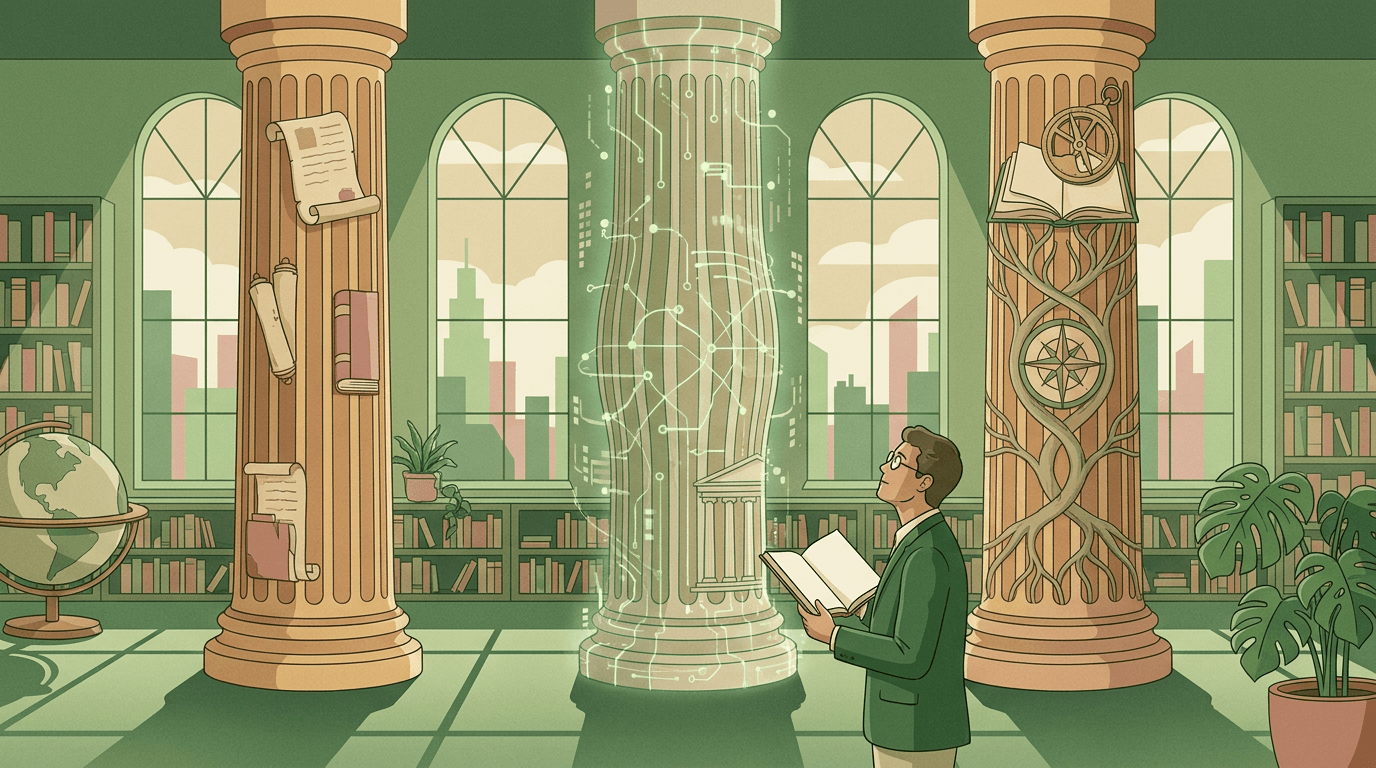 AI PublishingTrust
AI Doesn't Break Trust. It Changes Which Pillars Carry It.
Earlier this month, I was at a board meeting for a university press, talking about AI.
Jonathan Woahn·Jun 16, 2026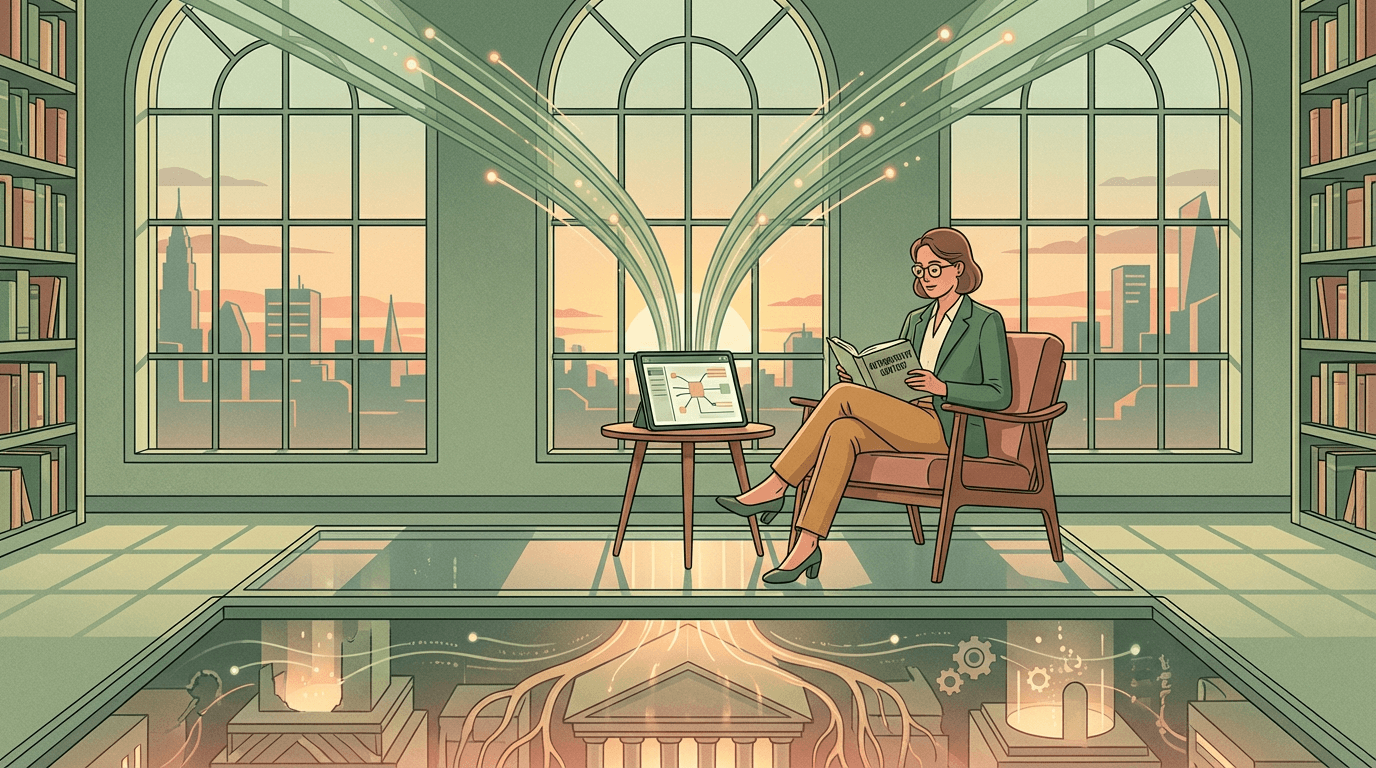 AI PublishingAI Content Strategy
Discovery Is Becoming an AI-Native Workflow
Discovery in scholarly publishing is no longer a search box sitting on top of a content repository. It is becoming a workflow layer that moves users from question to understanding to evidence with less friction. That shift is the starting point of a new essay on the KGL blog, written by Hong Zhou, VP of Product Management, and Adrian Stanley, Chief Business Development Officer, on why AI-native discovery is now table stakes and what it will take for publishers to get there without losing trust.
Pedro Matriciano·Apr 22, 2026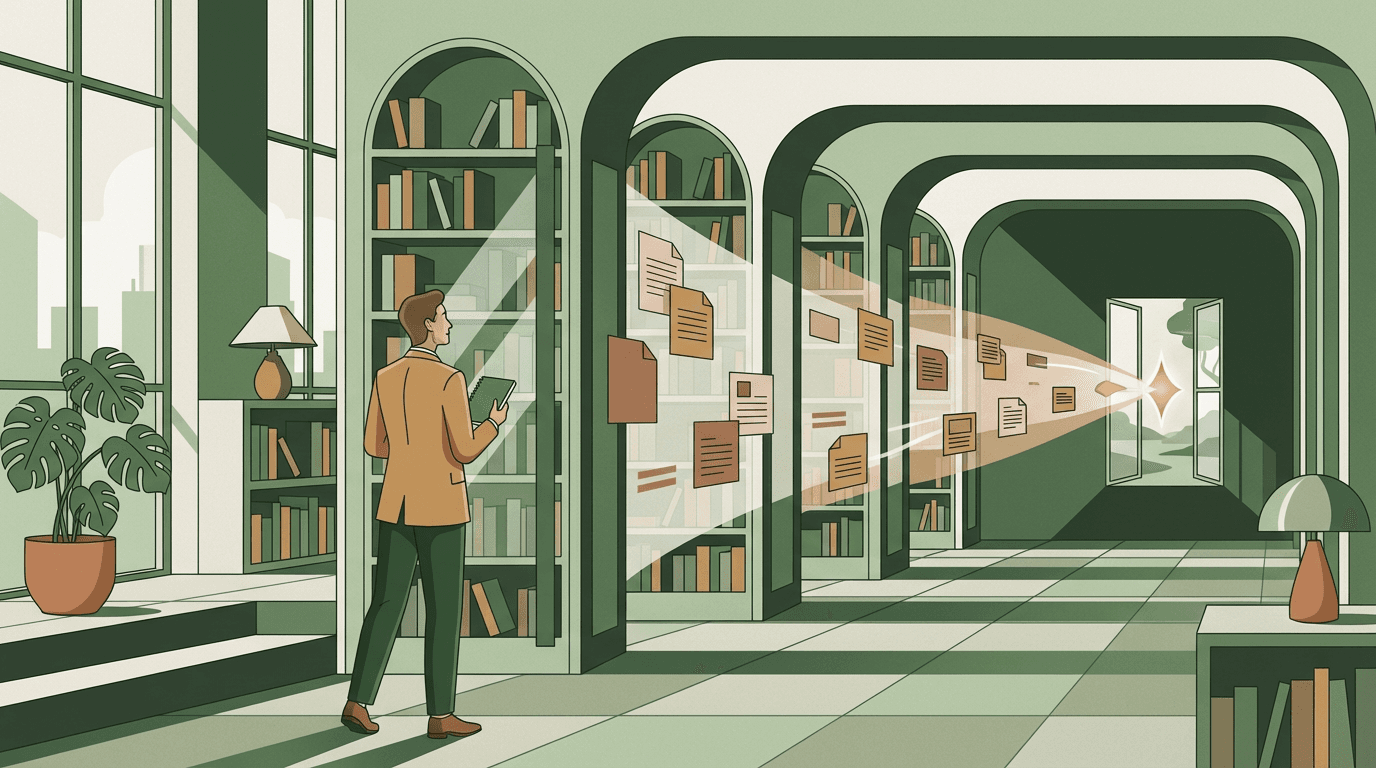 Content MonetizationAI PublishingAI Content Strategy
How Agentic AI Actually Consumes Publisher Content: Four Tiers Most People Haven't Mapped Yet
The publishing industry is focused on what happens when AI cites your content. But citation is just one layer. We break down the four tiers of how agentic AI actually consumes publisher content, from catalog access to the final click, and why understanding the full chain matters for any licensing conversation.
Jonathan Woahn·Mar 24, 2026 AI Publishing
Cashmere Partners with KGL to Bring Publisher-Grade Infrastructure to the AI Economy
Partnership integrates Cashmere’s premium data AI infrastructure with KGL’s publisher platform, enabling seamless commercialization, governance, and protection of premium content for AI.
Pedro Matriciano·Mar 9, 2026