 Fiber
Fiber Connect
 Omnipub
What Does It Mean for a Publisher to Be AI Ready?
Being AI ready spans strategy, philosophy, commercial terms, legal clarity, technical infrastructure and stakeholder communication. Most publishers have only covered one or two of them.
Being "AI ready" spans strategy, philosophy, commercial terms, legal clarity, technical infrastructure and stakeholder communication. Many publishers have only covered one or two of these topics.
Ask ten publishers whether they're "AI ready" and you'll get ten different answers, usually because they're each answering a different question. One means they've signed a licensing deal. Another means legal has cleared the risk. A third means someone in the C-suite has a point of view on generative AI and said so at a board meeting. None of these, on their own, is what the phrase actually requires.
We'd define it more precisely: a publisher is AI ready when it is ready in all aspects to commercialise its content through AI licensing. Not one aspect. All of them.
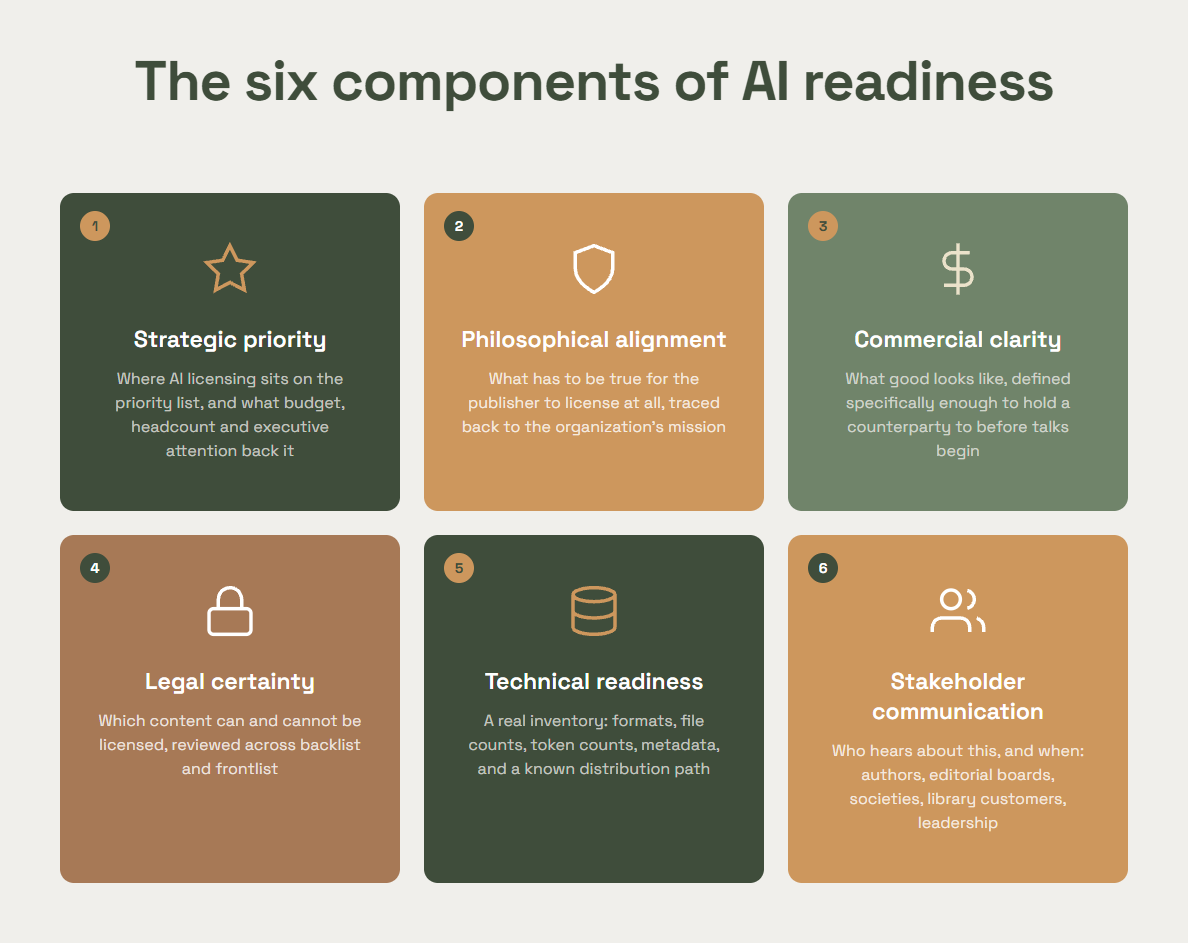
That distinction matters because AI readiness isn't a single decision a publisher makes once. It's six separate decisions, made across six different parts of the organization, that have to hold together at the same time. A publisher can be legally airtight and commercially sophisticated and still not be ready, because nobody has decided what the organization is actually comfortable doing. It can have a clear philosophical position and still not be ready, because nobody knows which file formats exist or how big the corpus is. Readiness is the product of all six.
1. Strategic priority
This is the resourcing question, and it comes before every other one. Where does AI licensing sit on the organization's priority list, and what budget, headcount, and executive attention will actually back that position? Strategy is ultimately a statement about where resources get allocated — a publisher that calls AI a priority but hasn't assigned anyone to own it hasn't made a strategic decision yet.
2. Philosophical alignment
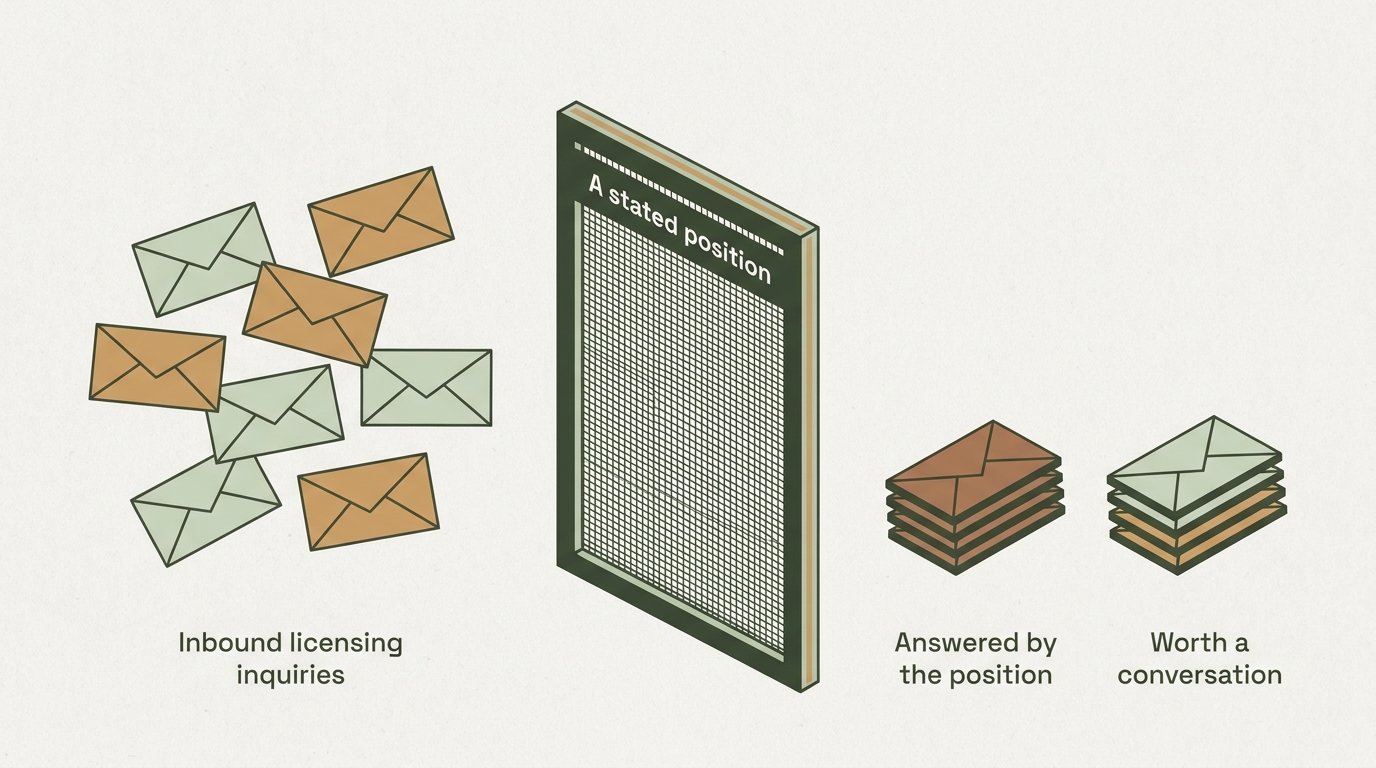
Before a publisher can negotiate, it needs to know what needs to be true for it to feel comfortable licensing its content at all — and that position needs to trace back to the organization's actual mission, not to whatever the market is doing.
Here's the kind of thinking we see from publishers who've done this work:
“Our author community very likely expects us to have a position that aligns with our goals as an organization, to be setting the rules of engagement on how companies may or may not use their content in AI, and to be protecting them from unauthorized scraping.”
From this fundamental principle, the position unpacks into a set of commitments, such as knowing where content goes and how it's used; operating with transparency wherever legally possible; placing content with partners who can be trusted to protect author IP; ensuring authors are never worse off by decisions made on their behalf; and explaining in plain language why the publisher is engaging.
None of this is a boilerplate, and every organization will have its own comfort levels. It's the difference between reacting to every licensing inquiry as a one-off and having a filter that makes most of those inquiries answer themselves.
3. Commercial clarity
Philosophy tells a publisher what it's willing to do. Commercial principles are where it decides what a good deal actually looks like. In practice, that means being able to say, before any negotiation starts, what "good" means in specific enough terms to hold a counterparty to it:
- Each proposed service or integration has to be described clearly enough to assess rights, risk, and commercial value before permission is even considered.
- Each license defines exactly what content is used, for what function, and by whom — not "AI training," but which model, which use case, which output.
- Some uses are simply out of scope. Licensing into open-source foundational model training, for instance, is a business-risk line many publishers won't cross.
- Terms scale with the scope, audience, and commercial value of the use — a narrow internal tool and a consumer-facing product don't get the same price.
- Scrutiny scales with downstream risk, not contract size. A small deal with unbounded redistribution rights deserves more attention than a large deal with narrow, well-defined use.
- Pricing logic has been thought through. This is one of the biggest hurdles we’ve seen to publishers realising revenue. There are AI buyers ready, but approvals and lack of pricing clarity hold deals back.
A publisher without this list isn't negotiating from a position. It's improvising one deal at a time.
4. Legal certainty
This is the constraint layer underneath the commercial one: knowing, with confidence, what content can and cannot be legally licensed. That means having actually reviewed the digital licensing clauses across the backlist and frontlist — and knowing exactly what the organization is obligated to do, including where it has to go back to rights holders for permission. A commercial team that doesn't know this is negotiating on ground that could shift under it.
5. Technical readiness
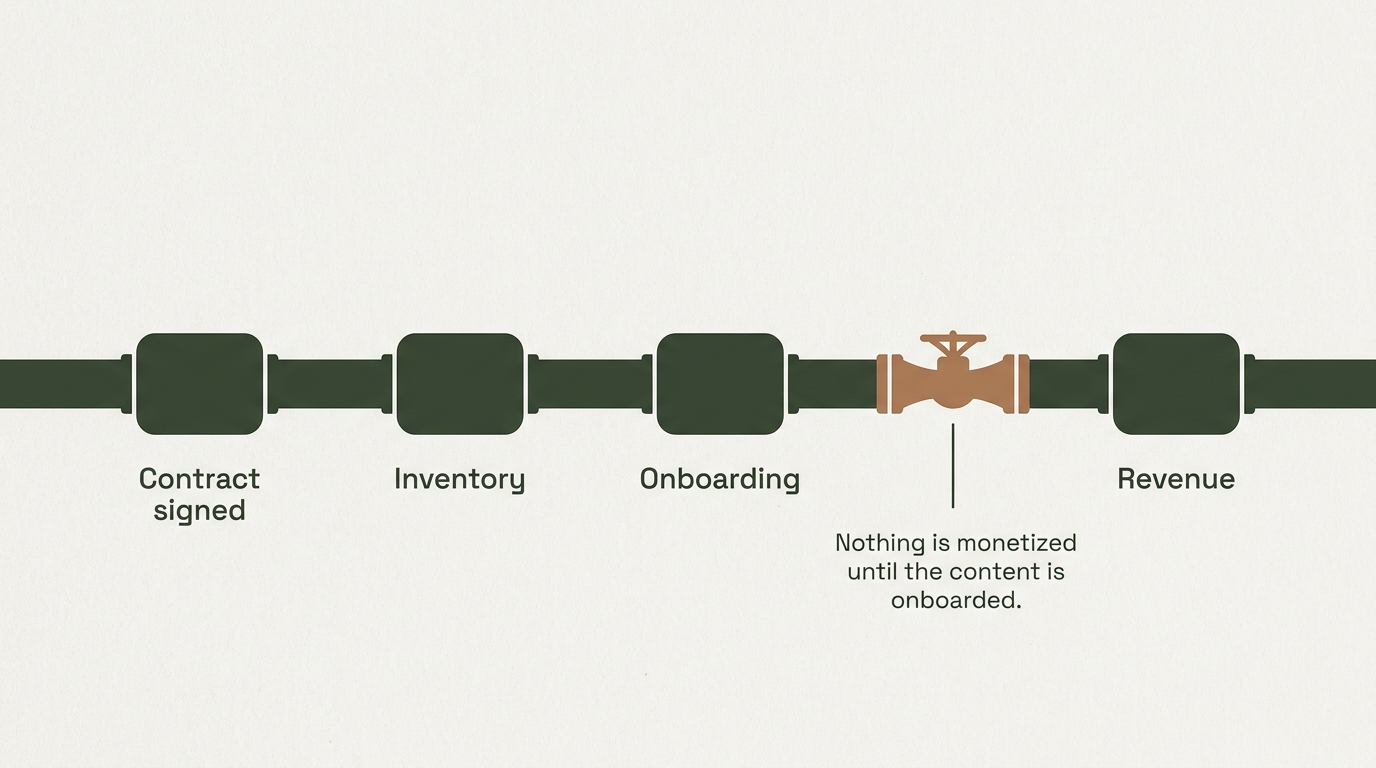
Philosophy and legal clearance define what a publisher is willing and able to license. This is whether it can actually deliver it. That means a real inventory: which content is available to license, in which formats (ePub, PDF, XML, and so on), and at what scale — file counts, word counts, token counts. It means having the metadata that makes that content usable, not just present. And it means knowing the distribution path: having the files ready and knowing how to distribute them for a use case.
This is the component most often overlooked, and it's the one that turns a signed contract into actual, deliverable revenue. Getting the contract agreed is only the first step. Nothing can be monetized until the content is onboarded. Publishers who can execute this rapidly and seamlessly will become the industry’s preferred partners.
6. Stakeholder management and communication
The last component is the one that makes the other five durable. It means mapping who the key internal and external stakeholders are — authors, editorial boards, societies, library customers, internal leadership — and having an actual plan for how each of them hears about this, and when. A licensing strategy that authors find out about from a press release isn't a communication plan.
Readiness is the whole set, not the strongest link
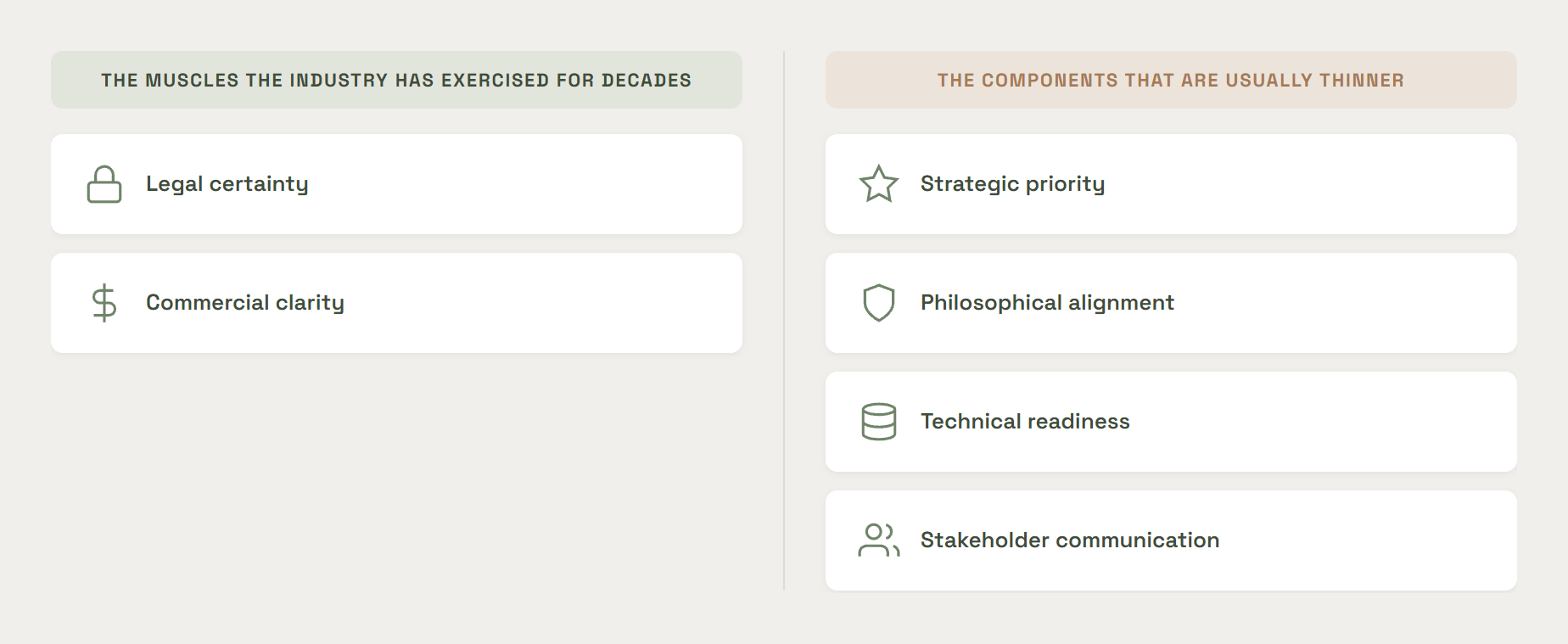
It's tempting to treat these as a checklist to work through in order. In practice, publishers tend to be strong in one or two areas — usually legal or commercial, because those are the muscles the industry has exercised for decades — and thinner elsewhere. That's the gap worth closing first, not the one that's easiest to talk about at a conference.
A publisher that's philosophically clear but technically unready can't fulfill the deal it's proud to have negotiated. A publisher that's technically ready but hasn't done the philosophical work will find itself negotiating principles under deadline pressure, one deal at a time, instead of once. AI readiness isn't the strongest of these six principles. It's all of them, at once.
Stay in the loop
Get the latest insights on AI, content licensing, and the future of publishing.
Read More
 AI PublishingAI Content StrategyTrust
The Scholarly Kitchen: The Third Time is NOT the Charm — Who Will Own How AI Participates in Scholarship? (Guest Post)
Twice the scholarly community built shared infrastructure and let someone else own what got built on top of it. A third layer is forming now, and it will decide how AI participates in scholarship rather than how it accesses content.
Jonathan Woahn·Jul 31, 2026 AI PublishingTrust
AI Doesn't Break Trust. It Changes Which Pillars Carry It.
Earlier this month, I was at a board meeting for a university press, talking about AI.
Jonathan Woahn·Jun 16, 2026 AI PublishingAI Content Strategy
Discovery Is Becoming an AI-Native Workflow
Discovery in scholarly publishing is no longer a search box sitting on top of a content repository. It is becoming a workflow layer that moves users from question to understanding to evidence with less friction. That shift is the starting point of a new essay on the KGL blog, written by Hong Zhou, VP of Product Management, and Adrian Stanley, Chief Business Development Officer, on why AI-native discovery is now table stakes and what it will take for publishers to get there without losing trust.
Pedro Matriciano·Apr 22, 2026 Content MonetizationAI PublishingAI Content Strategy
How Agentic AI Actually Consumes Publisher Content: Four Tiers Most People Haven't Mapped Yet
The publishing industry is focused on what happens when AI cites your content. But citation is just one layer. We break down the four tiers of how agentic AI actually consumes publisher content, from catalog access to the final click, and why understanding the full chain matters for any licensing conversation.
Jonathan Woahn·Mar 24, 2026 AI Publishing
Cashmere Partners with KGL to Bring Publisher-Grade Infrastructure to the AI Economy
Partnership integrates Cashmere’s premium data AI infrastructure with KGL’s publisher platform, enabling seamless commercialization, governance, and protection of premium content for AI.
Pedro Matriciano·Mar 9, 2026 AI PublishingAI Content StrategyAI Training Data
Synthetic Data versus Grounding Data: How AI Progresses Toward Intelligence
Both synthetic data and high-quality original content play essential, complementary roles in developing intelligent AI — one fuels imagination, the other ensures reliability.
Wyatt Grantham·Feb 27, 2026