 Fiber
 Connect
 Omnipub

Meridian: scholarly publishers bring trusted research into AI
Scholarly publishing has always cooperated on infrastructure. On November 3, Cambridge University Press, Johns Hopkins University Press and Princeton University Press announced that they are the Founding Publishers of Meridian, a University Press community initiative that brings
Scholarly publishing has always cooperated on infrastructure. On November 3, Cambridge University Press, Johns Hopkins University Press and Princeton University Press announced that they are the Founding Publishers of Meridian, a University Press community initiative that brings the same model to AI. Meridian is convened by Cashmere and powered by Cashmere's platform.
Meridian is a discovery gateway the publishers authorize
Meridian is the MCP discovery gateway for scholarly content, authorized by the University Presses themselves. Through it, the AI tools researchers already use get licensed access to peer-reviewed scholarship, and every answer carries a full citation and attribution.
Content reached through Meridian is never used to train or fine-tune AI models, and it is never sublicensed or redistributed.
Read rights and inference rights are two different things
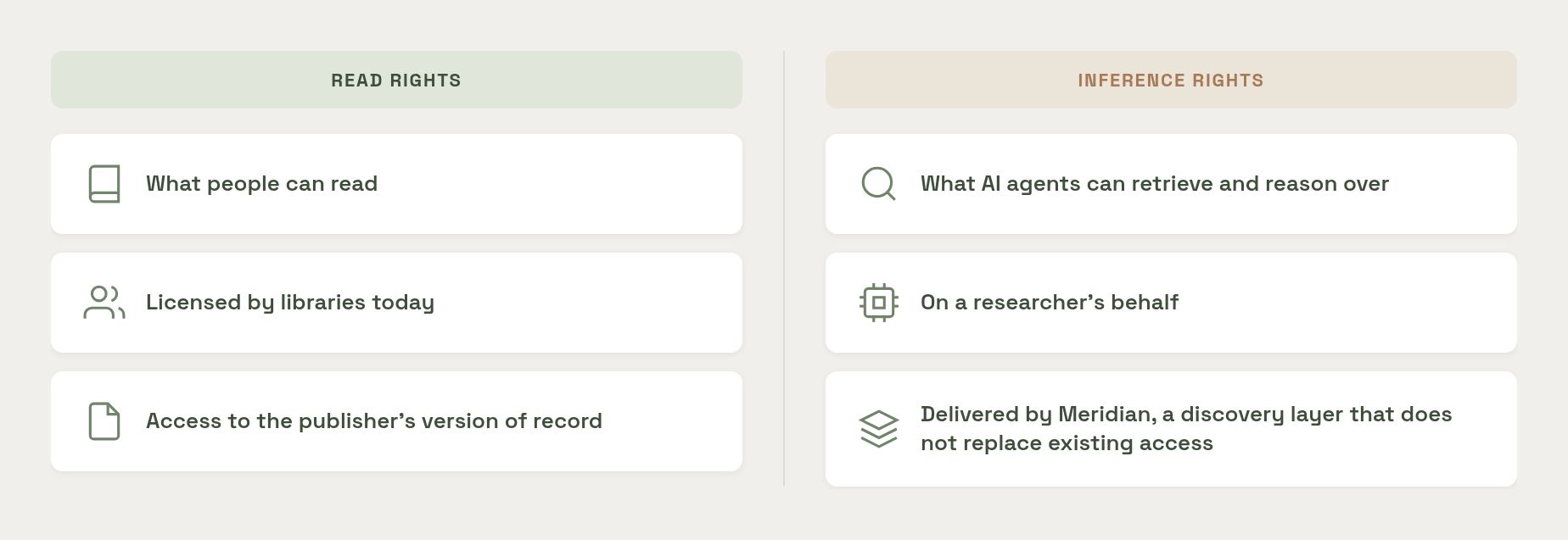
Libraries already license read rights. AI introduces a second kind of right. Inference rights cover what AI agents can retrieve and reason over on a researcher's behalf.
Meridian delivers inference rights. It is a discovery layer, and it does not replace existing access.
What it means for publishers
For a scholarly publisher, Meridian means one integration instead of one per AI platform. Participation is opt-in and non-exclusive, so a press can join without disturbing any other licensing deal or distribution channel, and titles can be withdrawn at any time.
Publishers also see which questions their catalog answered, where it ranks in content search and how often it is cited across AI tools.
What it means for libraries
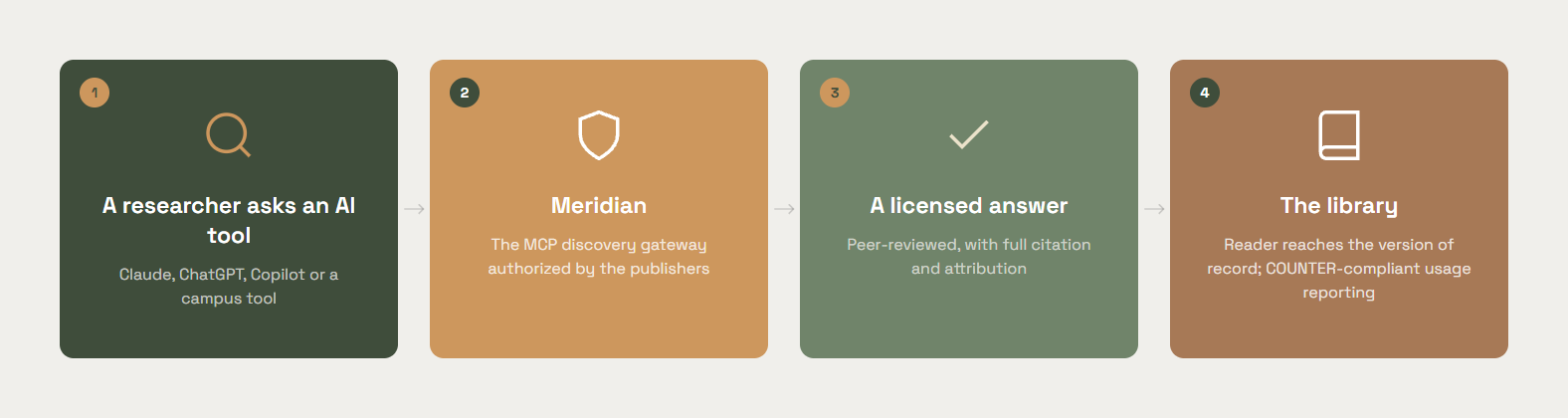
When a researcher wants the complete work, Meridian sends them to the publisher's version of record through their library. Libraries get COUNTER-compliant reporting on how licensed collections are used in AI-assisted research, which supports collection decisions and helps show the library's value to its institution.
There is no infrastructure to build and no AI contracts to negotiate one by one. A closed Beta Pilot opens to select institutions and libraries later this fall.
Governed by and for the scholarly community
The Founding Publishers lead Meridian through its Advisory Council, with institutional library representation forthcoming. The Council shapes Meridian's mission, principles, membership criteria and quality standards, and it becomes the board of directors when Meridian incorporates as an independent not-for-profit. Cashmere convenes Meridian and provides the platform it runs on.
In the words of the Founding Publishers
“The terms for how AI uses scholarship are being set right now, and university and other mission-aligned presses have an opportunity to take part in setting them. Johns Hopkins University Press has spent decades building trust with our partner publishers, scholars and readers, and Meridian lets us extend that trust into the AI systems that researchers and scholars are using on the terms so highly valued by our community.”
Barbara Kline Pope, Executive Director, Johns Hopkins University Press
“The opportunity to collaborate with peer presses, and to expand our partnership with Cashmere, aligns fully with the mission of Princeton University Press to bring the best scholarly content to the most generative global environments for knowledge making and exchange. Meridian is designed to help us adapt the discoverability and accessibility of PUP content to new research methods and methodologies while maintaining every integrity of the underlying intellectual property and copyrights, the valuation of that content, and our ability and agency to steward its engagement and impact.”
Christie Henry, Director, Princeton University Press
“As a university press, we are committed to protecting our authors’ rights while ensuring that high-quality trusted research is discoverable by those who need it, including through AI tools. This new partnership with Meridian will help libraries connect students and researchers with trusted scholarship from a strong and diverse group of participating university presses.”
Mandy Hill, Managing Director, Cambridge University Press
The full announcement is in the November 3 press release
How to take part
Libraries, university presses and other mission-aligned publishers can learn more and apply at meridianalliance.org.
Stay in the loop
Get the latest insights on AI, content licensing, and the future of publishing.
Read More
 AI PublishingAI Content StrategyContent Monetization
The Entmoot Decision
One of the world’s oldest, slowest industries is colliding with its newest, fastest technology. Publishing has always led more as a loose collaboration rather than a unified force. Similar to the Ents, until Isengard.
Jonathan Woahn·Oct 26, 2026 AI PublishingAI Content StrategyTrust
The Scholarly Kitchen: The Third Time is NOT the Charm — Who Will Own How AI Participates in Scholarship? (Guest Post)
Twice the scholarly community built shared infrastructure and let someone else own what got built on top of it. A third layer is forming now, and it will decide how AI participates in scholarship rather than how it accesses content.
Jonathan Woahn·Jul 31, 2026 AI PublishingAI Content StrategyContent Monetization
The Scholarly Kitchen: AI Isn't Going to Pay for Content — Part Two: The Path Forward (Guest Post)
The second installment continues exploration of AI's impact on content compensation, shifting focus to where genuine economic opportunity may emerge as AI systems become operationalized.
Jonathan Woahn·Feb 4, 2026 AI PublishingContent MonetizationAI Content Strategy
AI Isn't Going to Pay for Content (At Least Not How You're Hoping It Will)
AI training will not become the content windfall publishers hope for. The real economic opportunity lies in inference — and the window to shape its terms is open now.
Jonathan Woahn·Jan 21, 2026