 Fiber
Fiber Connect
 Omnipub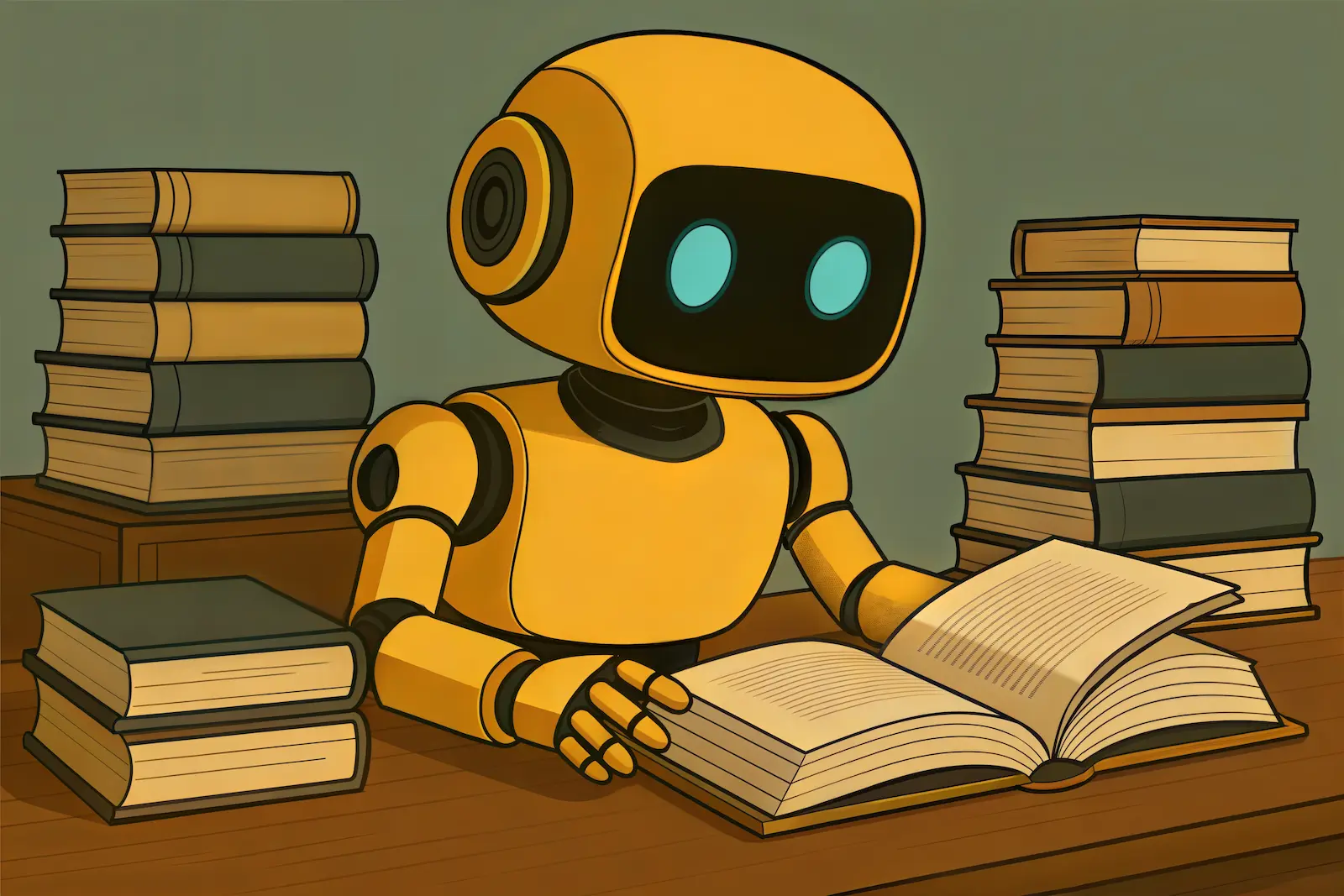
AI and the Future of Book Publishing (1 of 4)
This first article in a series of four sets the stage and outlines the key concerns that need to be addressed for AI and books to have a future together.
Designers: Jonathan Woahn, Michael Moulton / Tools: MidJourney, Recraft, Photoshop
A Dark Future for Publishers...If Nothing Changes
A few months ago, I had a conversation with a publishing consultant I'll call "Alex." Alex has spent decades in the book industry—working with publishers, authors, and distributors across every format and genre.
I asked Alex a simple question: "Where do you think book publishing will be in 15 to 20 years?"
Alex paused. Then said something that's stuck with me ever since:
"I fear unless something changes dramatically, AI is going to eviscerate book publishing."
I pressed for more. Alex's reasoning was straightforward:
Right now, AI-authored books aren't very good. They're derivative, formulaic, and lack the depth and nuance that human authors bring. But the technology improves exponentially. Give it five years, maybe ten, and AI-generated books will be indistinguishable from human-written ones in many categories.
When that happens, why would a reader pay $20 for a book when they can get a personalized, AI-generated version for free? Why would a publisher invest in a two-year editorial process when AI can produce comparable content in minutes?
Alex's prediction acutely captures a sentiment that many in the industry feel but few say out loud. It's a fear that's palpable at every publishing conference, in every boardroom, and in every conversation between authors and their agents.
Book Publishers' Legitimate Concerns
The concerns aren't theoretical. They're grounded in real events.
In one of the first major lawsuits against an AI company, the plaintiffs identified three core grievances about how their intellectual property was being used:
- Consent: Their IP was used without their permission or will
- Credit: No acknowledgment was given to the IP holder, despite their work influencing the AI's outputs
- Compensation: No financial remuneration was provided, despite their work providing significant value to the AI system
These three concerns—consent, credit, and compensation—form the foundation of nearly every publisher concern about AI. Let me illustrate with a concrete example.
I went to ChatGPT and typed a simple prompt: "Can you write me the entire first chapter of The Art of War?"
The output matched The Art of War nearly word-for-word. Every passage, every aphorism, rendered with remarkable fidelity.
Now, The Art of War is in the public domain—so no copyright was violated. But the demonstration raises an obvious question: if ChatGPT can reproduce a public domain text this accurately, what's happening with copyrighted content?
To test this, I made similar requests for copyrighted works. I asked for the first chapter of Harry Potter and the Sorcerer's Stone. ChatGPT refused. I asked for The 7 Habits of Highly Effective People. Same result. I asked for the Steve Jobs biography. "I'm not familiar with that specific book."
The AI clearly can control its outputs—it's choosing not to reproduce copyrighted material. But the fact that it was trained on that material in the first place is what concerns publishers. The model learned from these works. It internalized their patterns, structures, and ideas. And the authors and publishers received no consent request, no credit, and no compensation.
The Bottom Line?
I've spent the last five years working at the intersection of books and AI technology. Here's what I've come to understand:
Publishers' concerns are valid. Everything they fear AI can do—reproduce content, synthesize ideas, generate derivative works—it can do. The technology is real, it's improving rapidly, and it's already reshaping how people consume information.
But remember what Alex said: "unless something changes."
That qualifier is everything. Because generative AI isn't just a threat to book publishing—it's potentially the next great evolution of the medium. Books have survived—and thrived through—the printing press, paperbacks, audiobooks, and e-readers. Each transition required adaptation, new business models, and new ways of thinking about what a "book" is.
AI is the next transition. And like every one before it, it requires a joint vision between technology companies and publishers—a shared understanding of how AI and books can coexist in a way that benefits everyone: readers, authors, publishers, and technology companies alike.
That's what this series is about. Over the next three articles, I'll explore what needs to change, what's already changing, and what the future could look like if we get this right.
Who Is This Series For, and Why Should I Read It?
This series is for anyone in the book industry who wants to understand—clearly and practically—what AI means for their future. Whether you're a publisher, an author, an agent, a distributor, a technologist, or simply someone who loves books, the next four articles will give you:
- A clear understanding of the current AI licensing landscape and what recent deals between digital publishers and AI companies actually mean
- A framework for understanding training vs. inference and why this distinction matters enormously for publishers
- An honest assessment of why current licensing models break when applied to books specifically
- A vision for what the future could look like if the right infrastructure is built
- Actionable next steps for stakeholders who want to be part of the solution
I'll be honest: I'm optimistic about generative AI's potential for books and publishers. I believe this technology can unlock extraordinary new experiences for readers and extraordinary new revenue streams for the industry. My hope is that by the end of this series, you'll share some of that optimism—or at least understand why it's warranted.
One critical note: Understanding the concepts of "Training" and "Inference" in generative AI is essential for the rest of this series. If you're not familiar with these terms, I'd strongly recommend reading my companion article: A Beginner's Guide to Understanding Generative AI before continuing to Part 2.
This is Part 1 of a 4-part series on AI and the Future of Book Publishing:
- AI and the Future of Book Publishing
- The Current State of AI and Publishing
- Why the Established AI Content Licensing Model Breaks with Books
- Vision and Call to Action for AI and the Future of Books
Companion article: A Beginner's Guide to Understanding Generative AI
Stay in the loop
Get the latest insights on AI, content licensing, and the future of publishing.
Read More
 AI PublishingAI Content Strategy
What Does It Mean for a Publisher to Be AI Ready?
Being AI ready spans strategy, philosophy, commercial terms, legal clarity, technical infrastructure and stakeholder communication. Most publishers have only covered one or two of them.
Sue Hodgson·Aug 28, 2026 AI PublishingAI Content StrategyTrust
The Scholarly Kitchen: The Third Time is NOT the Charm — Who Will Own How AI Participates in Scholarship? (Guest Post)
Twice the scholarly community built shared infrastructure and let someone else own what got built on top of it. A third layer is forming now, and it will decide how AI participates in scholarship rather than how it accesses content.
Jonathan Woahn·Jul 31, 2026 AI PublishingAI Content Strategy
Discovery Is Becoming an AI-Native Workflow
Discovery in scholarly publishing is no longer a search box sitting on top of a content repository. It is becoming a workflow layer that moves users from question to understanding to evidence with less friction. That shift is the starting point of a new essay on the KGL blog, written by Hong Zhou, VP of Product Management, and Adrian Stanley, Chief Business Development Officer, on why AI-native discovery is now table stakes and what it will take for publishers to get there without losing trust.
Pedro Matriciano·Apr 22, 2026 Content MonetizationAI PublishingAI Content Strategy
How Agentic AI Actually Consumes Publisher Content: Four Tiers Most People Haven't Mapped Yet
The publishing industry is focused on what happens when AI cites your content. But citation is just one layer. We break down the four tiers of how agentic AI actually consumes publisher content, from catalog access to the final click, and why understanding the full chain matters for any licensing conversation.
Jonathan Woahn·Mar 24, 2026 AI PublishingAI Content StrategyAI Training Data
Synthetic Data versus Grounding Data: How AI Progresses Toward Intelligence
Both synthetic data and high-quality original content play essential, complementary roles in developing intelligent AI — one fuels imagination, the other ensures reliability.
Wyatt Grantham·Feb 27, 2026 AI PublishingAI Content StrategyContent Monetization
The Scholarly Kitchen: AI Isn't Going to Pay for Content — Part Two: The Path Forward (Guest Post)
The second installment continues exploration of AI's impact on content compensation, shifting focus to where genuine economic opportunity may emerge as AI systems become operationalized.
Jonathan Woahn·Feb 4, 2026